

Africa is often described as “the poorest continent in the world.”
It’s a phrase repeated in headlines, documentaries, and classrooms. But is it actually true — or is the reality more complex than the narrative?
To understand Africa’s situation, we need to look beyond the labels and examine the numbers carefully.
📊 What Does “Poor” Really Mean?
When people say Africa is poor, they usually refer to:
- low average income
- high poverty rates
- limited infrastructure
But poverty is not just about money. It’s also about:
- access to education
- healthcare
- opportunity
- how wealth is measured and distributed
The definition matters.
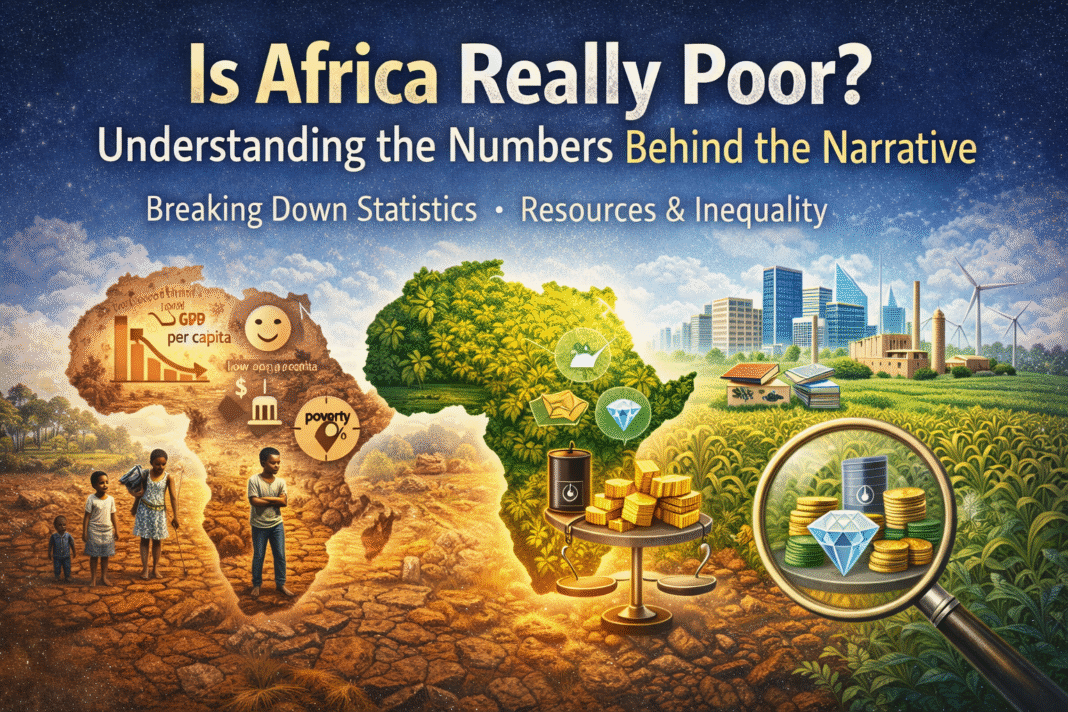
🌍 Africa Is Rich in Natural Resources
Africa holds:
- about 30% of the world’s mineral reserves
- vast oil and gas deposits
- the largest amount of uncultivated arable land
Countries rich in gold, oil, cobalt, lithium, and diamonds are labeled “poor” — not because resources don’t exist, but because value is often extracted, not retained.
📉 The GDP Problem
Africa’s poverty image relies heavily on GDP per capita.
But GDP:
- ignores informal economies
- doesn’t measure inequality
- doesn’t capture unpaid or local economic activity
Millions of Africans earn, trade, and survive outside formal systems, making official numbers misleading.
🧠 Poverty vs. Underdevelopment
Africa’s main challenge is not lack of wealth — it is underdevelopment.
This includes:
- weak institutions
- poor infrastructure
- limited industrialization
- historical exploitation and unfair trade systems
A country can be rich in resources and still struggle if systems don’t support growth.
👥 Inequality Tells a Bigger Story
In many African countries:
- wealth exists at the top
- poverty exists at the bottom
This gap creates the illusion that “everyone is poor,” when in reality wealth is unevenly distributed, just like in many parts of the world.
📈 A Growing Middle Class
Despite the narrative, Africa has:
- one of the fastest-growing middle classes
- booming tech, creative, and service sectors
- young entrepreneurs building startups
These stories rarely make headlines — but they are part of the data too.
🧾 Who Controls the Narrative?
Much of Africa’s image is shaped externally.
Stories of:
- crisis
- conflict
- poverty
are easier to sell than stories of progress, resilience, and complexity.
This doesn’t mean problems don’t exist — it means the picture is incomplete.
🧠 The Real Question
Instead of asking “Is Africa poor?”, a better question is:
Why does a resource-rich continent struggle to convert wealth into widespread prosperity?
That’s where the real conversation begins.
🕊️ Final Thought
Africa is not defined by a single statistic.
It is a continent of:
- contradictions
- challenges
- opportunities
Understanding Africa means questioning simple labels — and looking deeper at the numbers behind the narrative.